

The ash tree in Europe is under severe threat. A fungus is killing tree after tree, and there are not many healthy ash trees left. But researchers still believe in a solution. Now, experts have gathered in Malmö to save the ash tree.
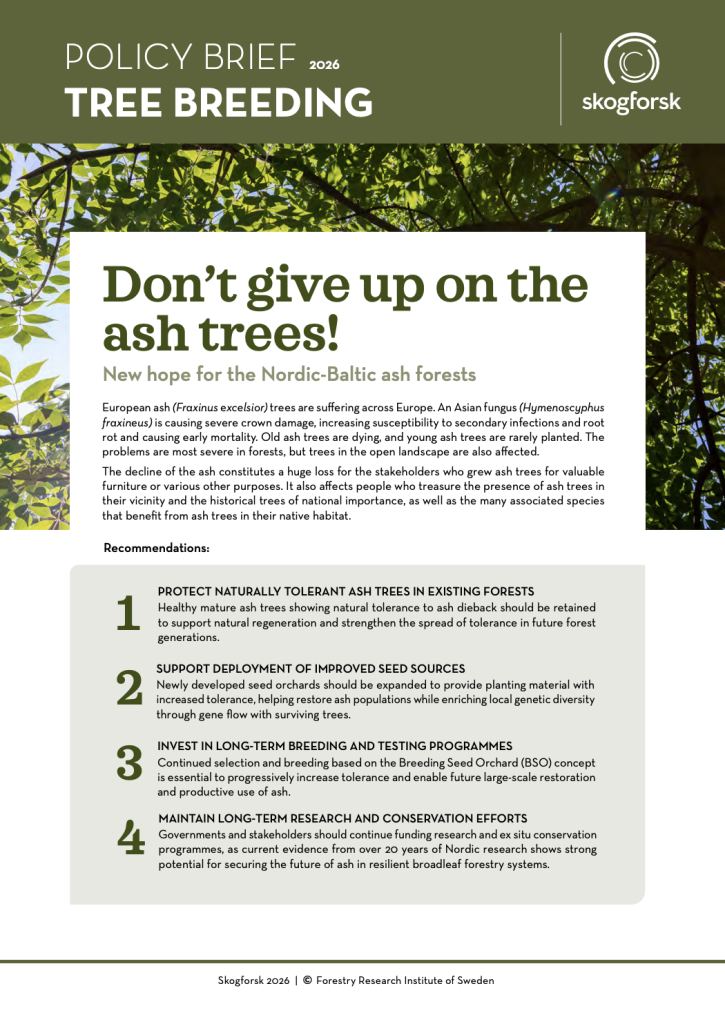 From the researcher network policy brief:
European ash (Fraxinus excelsior) trees are suffering across Europe. An Asian fungus (Hymenoscyphus fraxineus) is causing severe crown damage, increasing susceptibility to secondary infections and root rot and causing early mortality. Old ash trees are dying, and young ash trees are rarely planted. The problems are most severe in forests, but trees in the open landscape are also affected. The decline of the ash constitutes a huge loss for the stakeholders who grew ash trees for valuable furniture or various other purposes. It also affects people who treasure the presence of ash trees in their vicinity and the historical trees of national importance, as well as the many associated species that benefit from ash trees in their native habitat.
Recommendations from the researchers:
1 PROTECT NATURALLY TOLERANT ASH TREES IN EXISTING FORESTS
Healthy mature ash trees showing natural tolerance to ash dieback should be retained to support natural regeneration and strengthen the spread of tolerance in future forest generations.
2 SUPPORT DEPLOYMENT OF IMPROVED SEED SOURCE
Newly developed seed orchards should be expanded to provide planting material with increased tolerance, helping restore ash populations while enriching local genetic diversity through gene flow with surviving trees.
3 INVEST IN LONG-TERM BREEDING AND TESTING PROGRAMMES
Continued selection and breeding based on the Breeding Seed Orchard (BSO) concept is essential to progressively increase tolerance and enable future large-scale restoration and productive use of ash.
4 MAINTAIN LONG-TERM RESEARCH AND CONSERVATION EFFORTS
Governments and stakeholders should continue funding research and ex situ conservation programmes, as current evidence from over 20 years of Nordic research shows strong potential for securing the future of ash in resilient broadleaf forestry systems.
Nordic-Baltic partners were early to address the problem
Fortunately, not all ash trees are equally susceptible to the new disease. The presence of unaffected trees amid heavily infected ash stands was already observed and documented in parallel by Lithuanian, Swedish and Danish tree breeders and scientists early in the epidemic. They teamed up with the Nordic-Baltic forest pathologists who investigated the cause of the disease, which was still cryptic at the time. Nordic forest geneticists and pathologists soon formed a joint SNS supported network and initiated establishment of the very successful EU supported FRAXBACK COST network, taking the cooperation to the European level.
The Ash catastrophe is at European level, and the early establishment of cooperation across Europe was very important for the present scientific achievements.
Read the full policy brief here to get to know the current status of the ash, and why there are several reasons for optimism.