

Trees may seem still, but they are constantly moving. Every day, tree trunks expand and shrink by tiny amounts, often just a few micrometres – smaller than a human hair. These subtle movements reveal how trees grow, use water, and respond to environmental stress. Thanks to small sensors called dendrometers, scientists can now measure these changes continuously, opening a new window into the hidden lives of trees.
Text: Danielle Creek and participants from Nordic Dendrometer Network Meeting
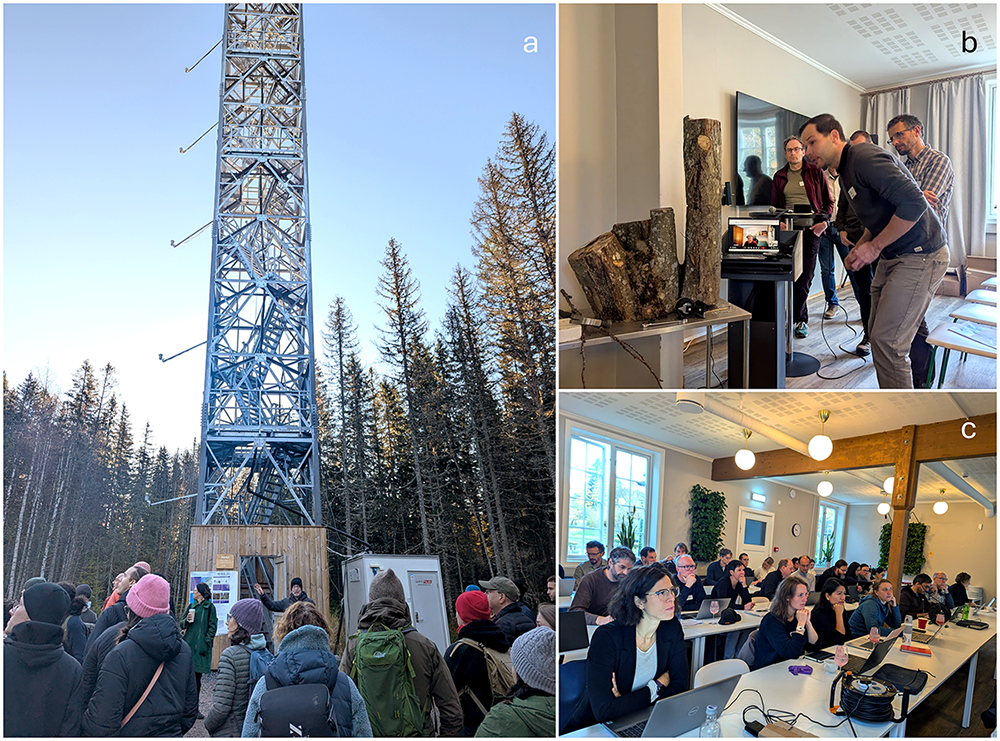
a Participants joined a fieldtrip to see dendrometers in action at the Hurdal ICOS monitoring site in Hurdal Norway. b Learning best practises in dendrometer installation from experts. c Listening to lightning research talks from all participants. Photos: D. Creek
In October 2025, 45 researchers from across the Nordics, Europe and the USA gathered in Ås, Norway, for the first Nordic Dendrometer Meeting. The aim was to connect researchers using these sensors and begin building an international network to better understand how forests are responding to climate change.
The “heartbeat” of the tree
Dendrometers are attached directly to tree stems and record tiny changes in trunk diameter over time. These measurements allow researchers to track growth in real time and detect when trees are under stress from drought, heat, or insect attack. As keynote speaker Kathy Steppe described, these measurements allow researchers to observe the “heartbeat” of trees, capturing the delicate balance between water transport and growth.
Another keynote speaker, Roman Zweifel, introduced TreeNet, a network monitoring more than 650 trees across Switzerland. One surprising discovery from this network is that trees grow only during short windows of favourable conditions, often at night, when water loss is lower. This challenges the traditional view that trees grow steadily throughout the growing season.
Answers to many questions
The meeting highlighted the wide range of questions dendrometers can help answer. Scientists presented research from Arctic forests, alpine treelines, Mediterranean ecosystems, tropical environments and of course Boreal forests of the Nordic countries. In Iceland, for example, dendrometer data revealed just how short and fragile the growing season can be, showing how trees must take advantage of brief periods of favourable weather.
Dendrometers are also increasingly being used in large monitoring networks, including TreeNet in Switzerland, TreeWatch in Belgium, and BorealNet in Norway. Because the sensors are relatively affordable and easy to use, they offer the potential to monitor forests at unprecedented scales. Some projects are even involving forest owners and citizen scientists to expand monitoring efforts.
A new international network
A key outcome of the meeting was the launch of a new International Dendrometer Network. A dedicated website and open metadata initiative, planned for 2026, will help researchers connect and identify where dendrometer data are being collected around the world.
By linking these efforts, scientists hope to build a clearer picture of how forests respond to climate change. Tiny daily movements in tree stems may seem insignificant, but together, they reveal powerful insights into the health and future of forests.